How Fairy Chimneys Form — and Why People Lived Underground in Cappadocia
Volcanic ash, a hard cap of rock and millions of years of rain built Cappadocia's fairy chimneys. The same soft stone let people carve whole cities underground.
In central Türkiye there is a valley where thousands of stone towers stand like a crowd frozen in place. Some are taller than a ten-storey building. Many wear a darker “hat” of rock on top. Local people call them peri bacaları — fairy chimneys.
They look magical, but the recipe is simple: soft rock, hard rock and time.
Step 1: a landscape made of ash
More than ten million years ago, three volcanoes around Cappadocia — Erciyes, Hasan and Göllüdağ — began erupting again and again. They buried the region under thick layers of ash. Over time the ash hardened into a rock called tuff.
Tuff is soft. You can scratch it with a knife. But in some places, a layer of harder rock, such as lava or basalt, settled on top of it.
Key idea: A fairy chimney needs two kinds of rock — a soft one that wears away easily, and a hard one that protects it.
Step 2: rain and frost do the carving
Rain, melting snow and frost slowly eat into the land. Water finds cracks in the hard top layer and cuts down into the soft tuff below. The soft rock washes away quickly. Wherever a piece of hard rock sits on top, the tuff underneath is sheltered, like a person standing under an umbrella.
Geologists call this differential erosion: different rocks wear away at different speeds. The result is a tall column of soft rock with a hard cap — a hoodoo, or in Cappadocia, a fairy chimney. The tallest reach about 40 metres.
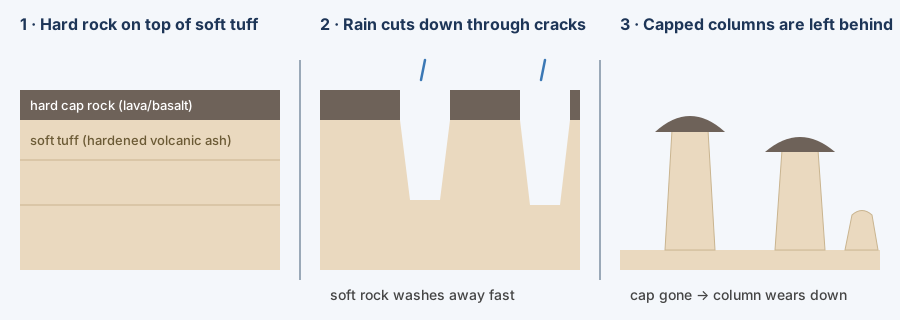 Differential erosion in three steps. Diagram: Landform Atlas.
Step 3: the countdown
Every fairy chimney is on a timer. The cap protects the column, but the cap itself is slowly undercut. One day it falls off, and then the unprotected tuff erodes fast, until the chimney becomes a rounded stump. Meanwhile, new chimneys are being cut out of the valley walls. The landscape is not finished — it is still being made.
Why people moved into the rock
The same softness that lets rain carve tuff also lets people carve it. For thousands of years, people in Cappadocia dug homes, churches, stables and pigeon houses into the rock.
They also dug down. In 1963 a resident of the town of Derinkuyu knocked through a wall in his basement and found a passage. It led into an underground city about 85 metres deep, with many levels, air shafts, wells and storage rooms. Some estimates say it could shelter up to 20,000 people with their animals.
Huge round stone doors could be rolled across the tunnels and locked from the inside. When raiding armies came, people went underground and waited.
Who built it?
The first tunnels may go back to the Phrygians, around the 8th–7th century BC. The city was greatly expanded during the Arab–Byzantine wars (roughly AD 780–1180). You may read that the tunnels were dug by early Christians hiding from Rome — it is a popular story, but historians have little evidence for it.
Painted churches inside the rock
In the Göreme valley, hundreds of churches were carved straight into the rock and painted with frescoes, many between the 10th and 13th centuries. The columns and arches inside often hold nothing up at all — they were carved to imitate built churches. The Dark Church (Karanlık Kilise) kept its colours unusually bright because it has only one small window, so very little light reached the paintings.
Quick check
| Question | Answer |
|---|---|
| What rock are fairy chimneys made of? | Tuff — hardened volcanic ash |
| Why do they have a cap? | A harder rock layer protects the soft tuff below |
| What is the process called? | Differential erosion (weathering and erosion at different rates) |
| Are they permanent? | No — once the cap falls, the column erodes quickly |
Cappadocia shows a big idea in physical geography: the shape of the land depends on what it is made of. Soft rock and hard rock, side by side, give rain something to sculpt.