How Ha Long Bay Was Formed — a Drowned Limestone Landscape
Ha Long Bay's nearly 2,000 islands began as seabed limestone, were carved by rain into towers, then drowned when the sea rose after the last Ice Age.
In the north-east of Vietnam, nearly 2,000 islands rise straight out of green water. Most are steep towers of grey rock, covered in jungle, with no beach at all. It looks like a mountain range that someone poured the sea into.
That is almost exactly what happened. Ha Long Bay is a drowned karst landscape — and its story has three chapters.
Chapter 1: a seabed full of shells
Around 300 million years ago, this area lay under a warm, shallow sea. Shells and skeletons of tiny sea creatures piled up on the seabed, layer after layer, and slowly turned into limestone. In Ha Long the limestone is around a kilometre thick.
Chapter 2: rain dissolves the rock
Later, movements of the Earth’s crust lifted the limestone above the sea. Then rain went to work.
Rainwater picks up carbon dioxide from the air and soil and becomes a very weak acid. Limestone is one of the few common rocks that this weak acid can dissolve. Water seeps into cracks, widens them, and over millions of years turns a solid block of limestone into a maze of towers, pits, caves and underground rivers.
This kind of landscape is called karst, after the Kras region on the border of Slovenia and Italy, where geologists first studied it.
Key idea: Most landscapes are worn down by water scraping rock away. Karst is shaped by water dissolving rock.
Many of Ha Long’s caves formed this way, when the land was dry. The famous Sửng Sốt Cave — named Grotte des Surprises (“Cave of Surprises”) by the French in 1901 — is a hollow left behind by water that once flowed through the rock.
Chapter 3: the sea comes back
During the last Ice Age, so much water was locked up in ice sheets that sea level was far lower than today. The area that is now Ha Long Bay was dry land — a forest of limestone towers on a wide plain.
When the ice melted, the sea rose. Around 8,000 years ago it flooded the plain and surrounded the towers. The hills became islands.
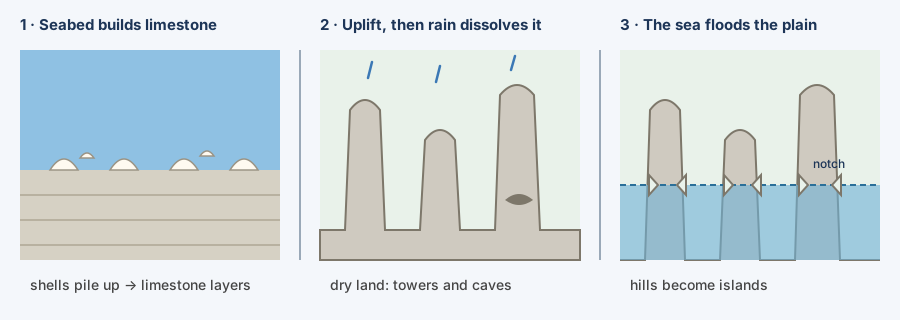 From seabed to drowned karst. Diagram: Landform Atlas.
You can still see the sea at work today. Around the base of many islands there is a deep groove called a notch, cut where waves and seawater dissolve the rock at the water line. Over time, notches undercut the cliffs until pieces collapse.
The people of the bay
People lived among these islands long before they were flooded. Archaeologists have named two prehistoric cultures after the area: the Soi Nhụ culture, more than 10,000 years ago, and the Hạ Long culture, around 4,000 years ago.
The name Hạ Long means “descending dragon”. A local legend says dragons came down to protect the land from invaders and spat out jewels that became the islands.
History adds a real battle. In 1288, on the nearby Bạch Đằng River, Vietnamese forces drove hundreds of wooden stakes into the riverbed and waited for the tide to go out. A large invading fleet was trapped on the stakes. Archaeologists have since found fields of these stakes.
Protecting a fragile place
UNESCO listed Ha Long Bay as a World Heritage Site in 1994 for its beauty and again in 2000 for its geology. In 2023 the site was extended to include the Cát Bà archipelago. Millions of visitors now come every year, which puts heavy pressure on the bay — from waste to the water quality around the islands.
Quick check
| Question | Answer |
|---|---|
| What rock are the islands made of? | Limestone, formed on a shallow seabed |
| What process shaped the towers? | Chemical weathering — rainwater dissolving limestone (karst) |
| Why are they islands now? | Sea level rose after the last Ice Age and flooded the land |
| What is a notch? | A groove cut by the sea at the base of a cliff |